
Return to Blogs
What Business Owners Should Actually Know
About Music Licensing, Spotify, MACP & Commercial Use
Walk into almost any café, boutique, salon, restaurant, or retail store today, and you’ll hear music playing in the background.
But here’s the problem:
Most business owners have no idea whether they’re actually using that music legally.
Some believe paying for Spotify Premium is enough.
Others think old songs are automatically free to use.
And many assume MACP controls all music rights in Malaysia.
The truth is a lot more complicated.
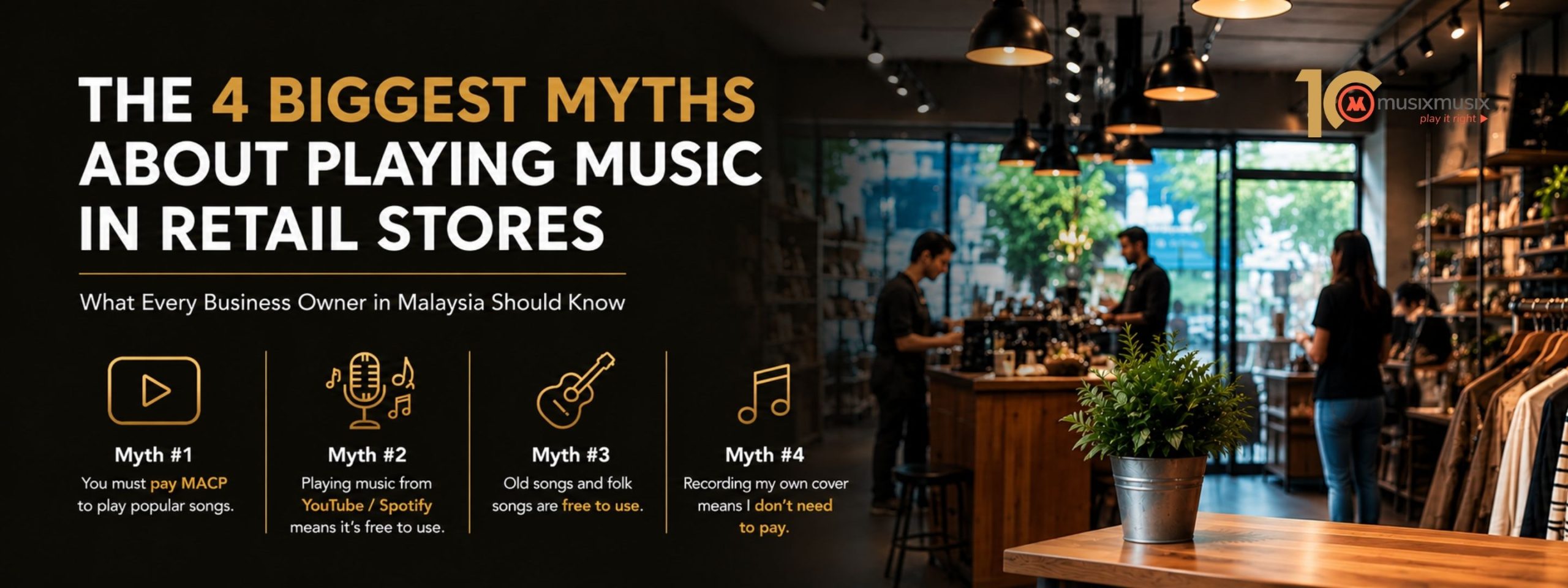
If you own a business in Malaysia, here are the four most common misconceptions about commercial music usage — and what you should really know before pressing play.
Not necessarily.
To understand why, we first need to understand how music licensing works in Malaysia.
There are three major Collective Management Organizations (CMOs):
These organizations collect royalties on behalf of their members whenever copyrighted music is publicly played in commercial spaces.
Years ago, this was relatively straightforward. Most mainstream artists were signed under major labels such as Universal Music, Sony Music, or Warner Music. Those labels were represented by CMOs, so businesses playing those songs were generally required to pay licensing fees.
But the music industry has changed dramatically.
Today, many internet artists, independent musicians, and KOL creators are not signed to traditional record labels and may not even be registered with any CMO.
In some cases, businesses can legally play their music simply by obtaining permission directly from the artist or copyright owner.
So the real issue isn’t whether a song is “popular.”
The real question is:
Who owns the rights, and have they authorized commercial use?
This is probably the most common misunderstanding among business owners.
Streaming platforms such as:
are designed primarily for personal listening.
Once music is played in a café, retail store, gym, or restaurant, it becomes a form of public performance or commercial use.
And that changes everything.
Even Spotify’s own business-focused solution, Soundtrack, still requires users to independently handle local copyright and licensing obligations depending on the country.
In other words:
A streaming subscription gives you access to the platform —
it does not automatically include commercial broadcasting rights.
Another risky misconception comes from YouTube uploads labeled:
“No copyright”
“Free for commercial use”
In many cases, these descriptions are written by uploaders who may not actually own the music rights.
And if copyright disputes happen, YouTube usually won’t be responsible — the liability falls on the business owner.
Convenient access to music does not equal legal authorization.
Sometimes yes. Sometimes no.
This depends on whether the music falls under the public domain.
In Malaysia, musical compositions generally enter the public domain 50 years after the death of the songwriter or composer.
Once that happens, the melody and lyrics are no longer protected by copyright and can typically be used freely.
But there’s an important detail many people overlook:
The composition and the recording are separate copyrights.
Take the classic folk song Rasa Sayang as an example.
The song itself may be considered public domain because it has no clear original author and has existed for generations.
However, if you play:
you may still be using copyrighted:
because the recording itself still belongs to someone.
The song may be ancient.
The recording may not be.
Not always.
Many business owners think:
“If I sing it myself, record it myself, or play it with my own instruments, then it’s completely legal.”
But if the song itself was written by someone else, songwriter copyrights may still apply.
That means even self-recorded cover versions can still involve licensing obligations related to the composition.
Of course, if both:
are entirely your own original creations, then you’re generally free to use them commercially.
But beyond legality, there’s another question business owners should ask themselves:
Is the music actually right for your brand?
Because store music isn’t just background noise anymore.
Music affects:
The right playlist can make a café feel cozy, a boutique feel premium, or a retail space feel energetic and modern.
That’s why smart businesses don’t just focus on “legal music.”
They focus on strategic music.
In markets like Malaysia, Singapore, Indonesia, and Thailand:
This means commercial playlist planning must consider:

In Malaysia today, many businesses are moving beyond traditional licensing confusion by working with professional commercial music providers.
Companies like musixmusix specialize in curated music solutions designed specifically for commercial environments.
With over 10 years of experience in Malaysia’s retail music industry, musixmusix provides licensed music and customized playlists for cafés, malls, restaurants, retail brands, and lifestyle businesses nationwide.
Their philosophy is simple:
Because great store music should do more than avoid copyright problems. It should strengthen your brand, improve customer experience, and create the right atmosphere for your business.
MusixMusix Sdn. Bhd. (1198297-H)
81-1, Jalan Medan Setia 1,
Bukit Damansara,
50490 Kuala Lumpur
© Copyright 2025. All rights reserved. MusixMusix Sdn. Bhd.